 10-29-2017, 09:11 AM
|
#33
|

Drives: 2010 Camaro
Join Date: Nov 2009
Location: Denver
Posts: 1,383
|
Here is what GM sends with every replacement engine, LS, LT, etc. and is absolutely the best most effective way. We just go to 5k RPM instead of 4500. And no, NO engines come already broke in from the factory.
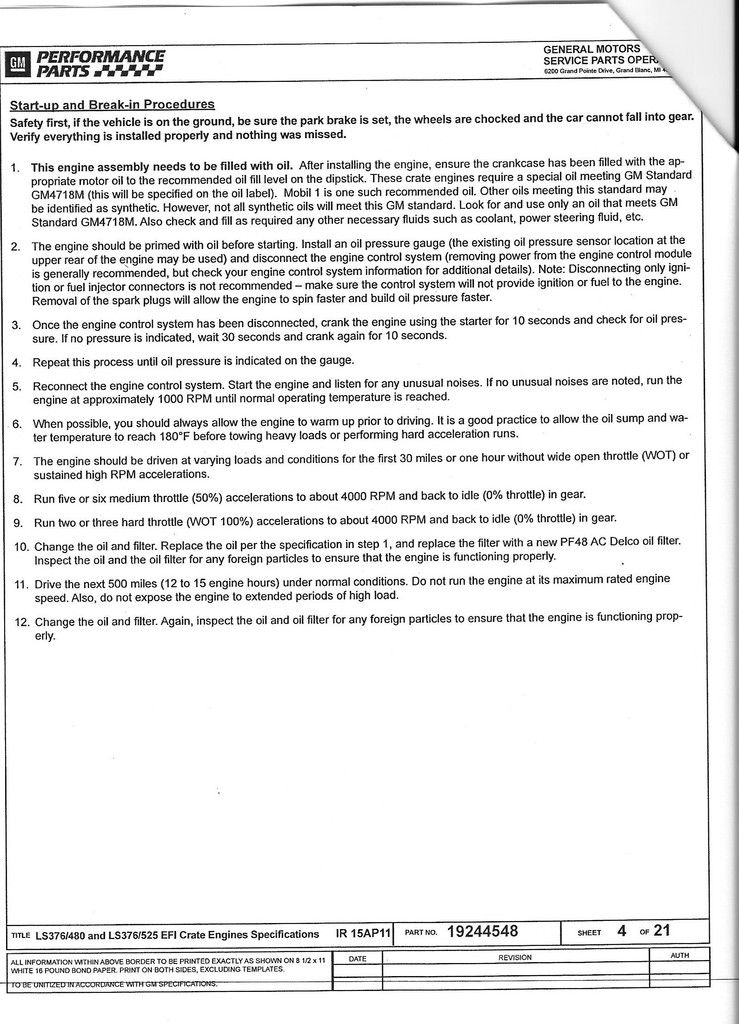
The reason you the consumer does not see this is the liability involved with instructing a "un trained" consumer to follow this.
Think about the owners manual instructions. First, first oil change at 3000 miles? After a high number of catastrophic engine failures GM now released bulletins to change factory fill oil on the Z06 at 500 miles. These failures were caused by several factors all related to leaving the factory fill oil that is full of damaging abrasive compounds in for that long. The ONLY reason Automakers tell people they can go 3-5k miles before the first oil change is pure marketing to appeal to today's buyer that does not want to be troubled with having to come in for service so soon. This has nothing to do with whats best for the engine longevity.
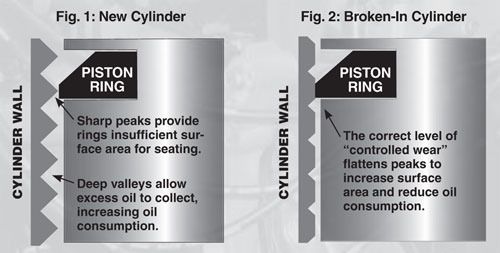
Now lets look at one of the most important aspects of the break-in process as far as the engine is concerned. The crank and cam journals are polished to perfection so nothing to wear in there. Bearings have very little shedding of metal as they are also close to perfect when installed. Rocker arms? Nope, needle bearing pivots and only the end that rides on the valve stem ends does any "break in". That as well is very minor and requires no "easy" driving, in fact the best is varying RPM's from idle to 5k for best results. Rare to ever see failures there. Pushrods and lifters? Again, other than very minor wear in of the cam lobes, also best done at higher RPM's. Now, the most critical....the piston rings. The rings are your only barrier between the combustion chamber and the crankcase. All engines have some blow-by, but the goal is the least possible. In order to do this, the rings must wear in, or abrade to the shape of the cylinder walls. And in doing so they generate a large amount of iron filings. And how this is done is with the abrasive cross hatch hone pattern we cut into the cylinder walls before assembly. Here are some illustrations to show what happens when this goes as planned:
BUT, this must occur evenly, and in the first few hundred miles or this is the result that causes oil consumption and excessive blow-by issues:
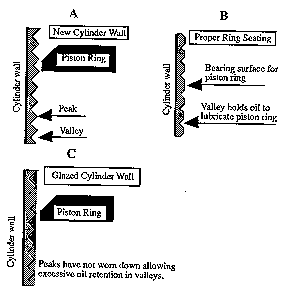
Why? In the "old days" engines came factory filled with a low viscosity "break-in" oil. This oil was just enough protection that if driven easy, would protect the bearings and other surfaces while still allowing penetration of the protective layer so the rings could seat quickly and correctly. Oil was then changed by 500 miles and then a good oil filled and you could drive hard. Today, these engines come filled with a syn blend that is far too protective so it takes some "force" to penetrate that lubrication barrier and allow the "wear in" of the rings and cylinder walls for a good seal. So, if you follow the owners manual, you probably have a 50/50 chance the rings will seat well enough to not use excessive oil, but 50% that they will not. So if they do not fully seat, and seat evenly in the first few hundred miles, that short window ends when a hard glaze sets onto the cylinder walls and covers the cross-hatch so little to no further seating can occur. When you follow GM's instructions for Techs, you find the engine braking will put even forces as occurred during acceleration and the best possible even wear-n occurs resulting in the best seal possible. No engine oil consumption, minimal blow-by, and more power due to the better seal.
Valve springs need several heat cycles to break them in right. Heat up and cool down.
What is in the crankcase when your new car leaves the factory? Well, the silicates and other foaming causing compounds present from assy and machining coat the surfaces and contaminate the oil. Also the different metal filings shed from ring seating and other minor wear-in. Assembly debris suck as brush bristles, shed abrasives, and other metal that comes loose when run that adhered to the surfaces. Casting flash being common. Here is an example of a filter:

Above shows stainless steel brush britles that were shed during assy. NOT good to circulate in the oil. The filter trapped it, but it most likely did some wear/damage before this.

This shot shows shiny silver (aluminum) and gold (brass/copper) metal that comes from casting flash and some bearing material as the particles have been causing premature wear (this was 500 mile first change).
What about the trans and rear diff and brakes? Brakes are bedded with a few hard stops and never keeping pedal depressed so the rotos can heat cycle evenly. Nothing in the trans has to wear in, all is as it should be. Some minor gear meshing. Rear diff 50 miles.
So, reading owners manuals today always makes me chuckle at how they are written. Minimal accurate advice for getting the most trouble free life from your new vehicle, and most to shield the company from liability, and of course reinforcing marketing strategy.
Hope this helps, but bottom line is ONLY do as you feel comfortable doing. You own the vehicle and you have to treat it as you choose.
|

|

|