Xaxas,
What part of Florida are you in? We have our R&D partner near Sarasota/Tampa you could visit for a good crash course on all of this, and they would install a system on yours no charge, just purchase our system.
To answer your question, and this is far to common, most mistakenly assume the crankcase should be under pressure and you NEVER want that. You always want suction resent so pressure can't build to begin with.
And here is how the fresh/clean side of the PCV system works. Filtered fresh air should always be drawn IN to the crankcase. It passes first the air filter, then the MAF sensor (as this incoming air ultimately becomes part of the air/fuel mixture in the combustion chamber), then incorporated into the MAF is the IAT (Intake Air Temp sensor), and then the MAP sensor. So before any of it reaches the combustion chamber it is measured by each of those sensors so the ECU can determine the amount of fuel, ignition timing, and more that is needed to achieve the correct targeted A/F ratio. From there the spent exhaust gasses pass the upstream O2 senors (sensors 1) and this data lets the ECU know what needs to be done to meet the pre-set parameters in the tune. If it's lean, more fuel is added. If rich, some is taken away.
So, when you mistakenly assume pressure is always going to be present, and think "I'll just put a breather here to release pressure and all will be fine". Most have this mindset as there has been no training in automotive tech schools for decades on the PCV system and all it does. So when you do this, at idle and deceleration and light cruise, the intake manifold produces the vacuum needed for evacuation (a proper system remember pulls suction on the crankcase, if you allow pressure the rings can't remain stable and seal properly and all sorts of negative issues). So it will pull in air that has NOT passed the MAF/IAT/MAP sensors so it confuses the ECU because none of the data coming in matches the tables as expected in the tune, so to protect the engine it adds more fuel. Then the upstream O2's tell the ECU it is too rich, so it takes fuel away. It will show in a scan short term trims adding and subtracting fuel so things are far from ideal. So we NEVER vent or use breathers (at least the few that understand this). Those that do vent are using technology from the pre 1960's and that leaves most of the wear and damage causing substances in the crankcase to mix with the oil and attack the metal internal parts and more.
Here is what a sample from our systems consists of when spun in a centrifuge and then analysised in the lab:
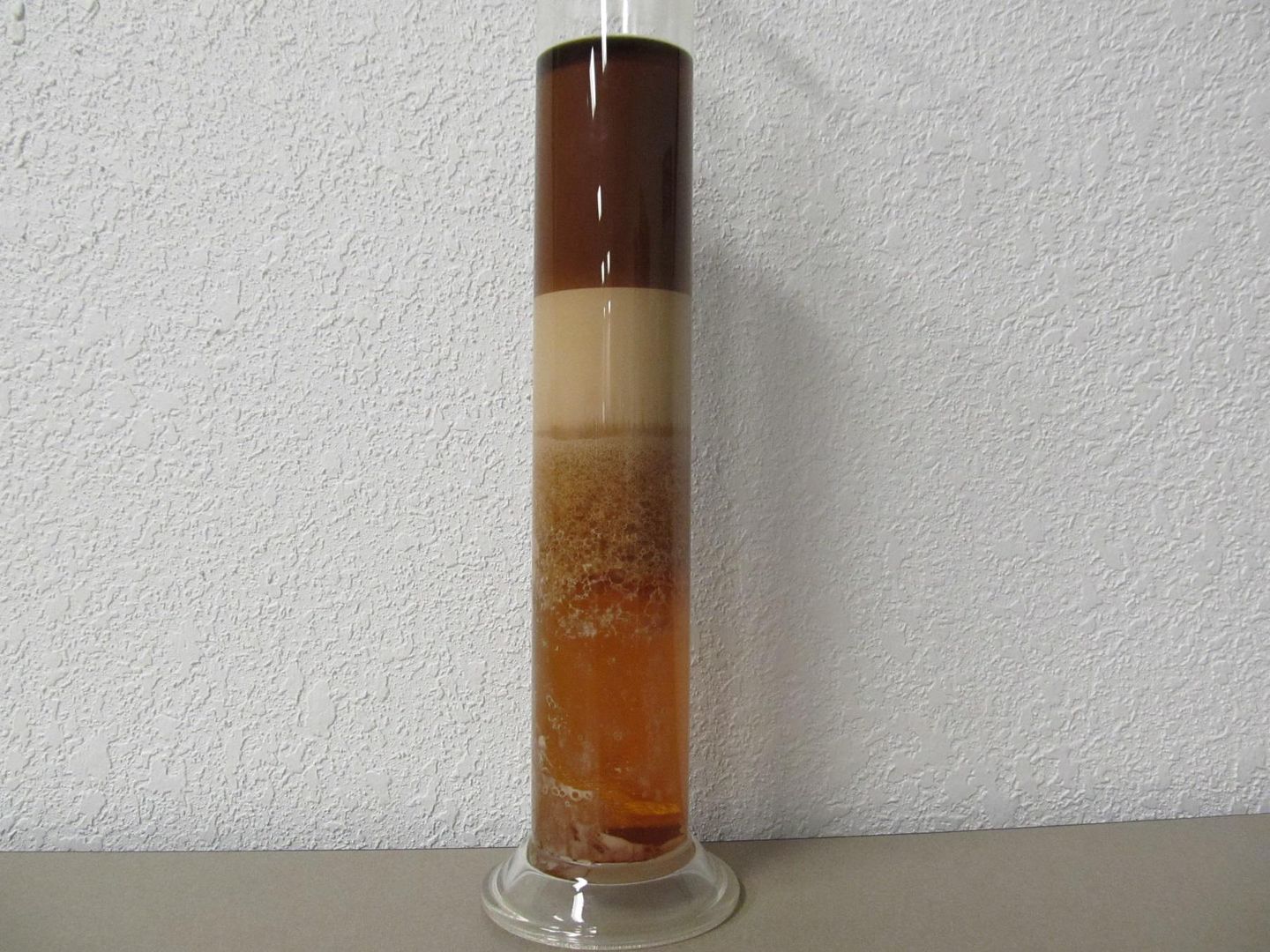
This consists mainly of 70% water and acids.
23% is raw unburnt fuel
7% is actually oil, but it is saturated with the wear and damage causing soot, ash. and carbon. The abrasive substances that cause wear.
So these would have been simply ingested without our system installed.
Re watch that video a few times to understand better, and ask questions on any part not totally clear. Education is key as you should never blindly make a decision based on an add or because someone else told you to. Understand each function the PCV system provides (only one is pollution related) and how each affected part of the engine relies on one or more. I mentioned the piston rings and retaining stability. In engines of old (prior to the 1990's mainly) all had a high tension piston ring so this was not an issue, but as more demands of better fuel economy popped up, several changes were made. One is the piston rings were now similar to what we had been doing with race engines for decades. We used lighter low tension piston rings and today that's standard. That frees up HP and increases fuel economy, as well as running far too thin of oils to properly protect. So, all piston rings are now low tension, but several factors are critical to maintain stability, and the one we can control is the need for pressure above the rings and suction below. We are one of the only systems that provides this.
Lots more to learn that were happy to share.