Quote:
Originally Posted by BlueinTN

You may want to take time and explain the relationship between fuel flow and pressure. People get confused with pressure and volume all the time.
|
Looking at the whole system, our critical areas to look at are:
-Low Side Fuel Flow Rate
-Low Side Fuel Pressure at the High Side Inlet
-High Side Fuel Pressure at the Injector Inlet
-High Side Injector Fuel Flow Rate at the Outlet
-High Side Injector Fuel Injector Pressure at the Outlet
To start, you need a
specific amount of fuel to support the intended power level targets. You can calculate this in multiple ways. Once you the amount of fuel you need (in flow), you need to make sure your low side fuel system can support that amount. This can be done with an aux pump system running in parallel with your factory pump, or a new drop in system like the fore unit.
Next, you need to
verify that your high pressure pump is receiving the amount of fuel that the fuel pump is trying to supply. You also want to make sure that the high pressure pump is receiving that fuel at or above 60 psi fuel pressure. If all checks out on the low side, you can move onto the high side.
The factory high pressure pump's output can be changed with a larger fuel lobe. In addition to this pump, you can run the Katech XDI in parallel to gain additional output. These rates can be found here:
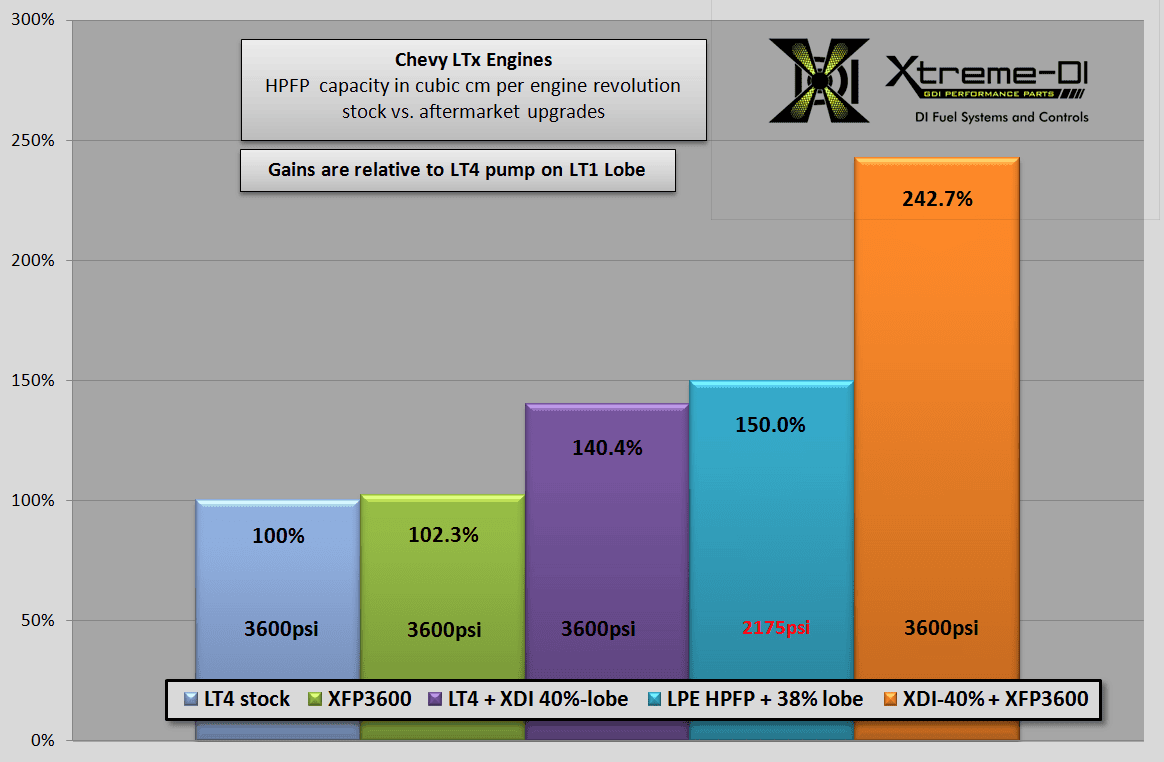
On the left, you have the % increase in fuel flow percentage, and at the base of each bar is the amount of max pressure that the pumps can support. Moving onto the injector,
the important part about this is the higher operating rail pressure and the size of the injector. If the injector is too small or there is too little rail pressure, you will have to keep the injector open much longer in order to provide the amount of fuel required by the engine.
At higher RPM, the window that is available to inject fuel into the combustion chamber is much smaller than the lower RPM window. Therefor, you need to make sure that the injector can flow the amount of fuel needed in the amount of time that is available for fuel injection.
This is where the higher operating rail pressure and the larger XDI injectors come into play, you will be able to flow the large amounts of fuel into the combustion chamber in the short time windows that are available for injection.
The fuel system is one large system that needs to work together in order to achieve the desired amounts of power. All areas need to be addressed in order to support high horsepower applications.
To answer your questions about fuel flow and pressure:
Fuel flow is simply the amount of fuel (volumetric flow rate or fuel flow rate) that can be delivered through the fuel system. A pump may be capable of x amount of lph but the feed lines may be a restriction, so volumetric flow rate would be more accurately measured at the end of the feed line going into the high pressure pump. You can have x-lph flowing out of a 2" tube with near no pressure, or you can have x-lph flowing out of a .25" tube with a ton of pressure.
Pressure is the is the amount of force per cross sectional area (pound per square inch, newtons per square meter etc) that is measured at a given point in the fuel system. As the length of fuel line increases, the pressure and fuel flow decreases.
Both fuel flow drop and pressure drop can be calculated, an example of this can be shown below:
