 01-01-2018, 10:20 AM
|
#5
|

Drives: 2010 Camaro
Join Date: Nov 2009
Location: Denver
Posts: 1,383
|
We would like to chime in here and try and understand why some are allowing pressure to build in the first place to the point of venting? If you follow any type of Professional Motorsports, aside from Top Fuel where most oil is pushed from the crankcase in a single run, and a 4-5 gallon catch tank is used, none vent. The reasons are many, and here are the main ones:
1. The pistons have to fight pressure if the crankcase is not under constant evacuation and this results in power lost from this parasitic restriction.
2. Today's engines all come with low tension piston rings. These rely on suction below, and pressure above to properly maintain seal and stability. When you allow pressure to build and vent, you create a condition known as "ring flutter" where the rings enter a state of rapid vibration at high RPM's. This is especially common with forced induction.
3. All engines experience blow-by to some extent. Contained in this blow-by are several compounds that cause wear and damage obver time to the internal components. The main ones are as follows:
1. Water
2. Raw fuel
3. Acids (mainly sulfuric)
4. Abrasive particulate matter (ash, soot, and carbon)
So by venting and not continuing to evacuate at all modes of operation, especially with a boosted engine, anytime your not at idle or deceleration your allowing most of these to accumulate and settle in the crankcase. As most internal wear comes from just these compounds, that is (and yes, many have run for a year or so and the engine has not blown up, but that is not the point, it is the cumulative wear your accelerating over time).
The best solution is a belt driven vacuum pump as most all Professional Motorsports use, but on the street these will not last. The E2-X Dual valve systems, especially the Ultra designed for big boost, big power builds provides full time evacuation no matter what mode of operation. The intake manifold vacuum is used for evacuation during non-boost operation, and the primary checkvalve closes once it detects boost and the secondary valve opens to continue evacuation using the suction generated via the Venturi Effect at the inlet of the turbo/centrifugal SC so no matter what, constant evacuation suction is pulled and pressure is never allowed to build in the first place. The contaminants entering are evacuated (sucked out) at all times, and oil remains contaminant free longer, providing more protection, less power loss from windage issues, and enhanced piston ring stability and seal.
Think of your crankcase as a smoke filled room. There is a vent in the floor spewing smoke steadily (blow-by). You have 2 windows on your room. Open one and your "venting". Excessive pressure is relieved, and a small amount of smoke also exits, but the room remains filled with smoke. Now open the opposite window and place a fan in it sucking out, and the room immediately clears and remains clear even though the vent is still spewing the same amount of smoke. Think of your crankcase the same way.
Here are illustrations provided by Turbonetics Head of Engineering where they did extensive testing of our system. They found it to be the ONLY system that properly addressed these issues.
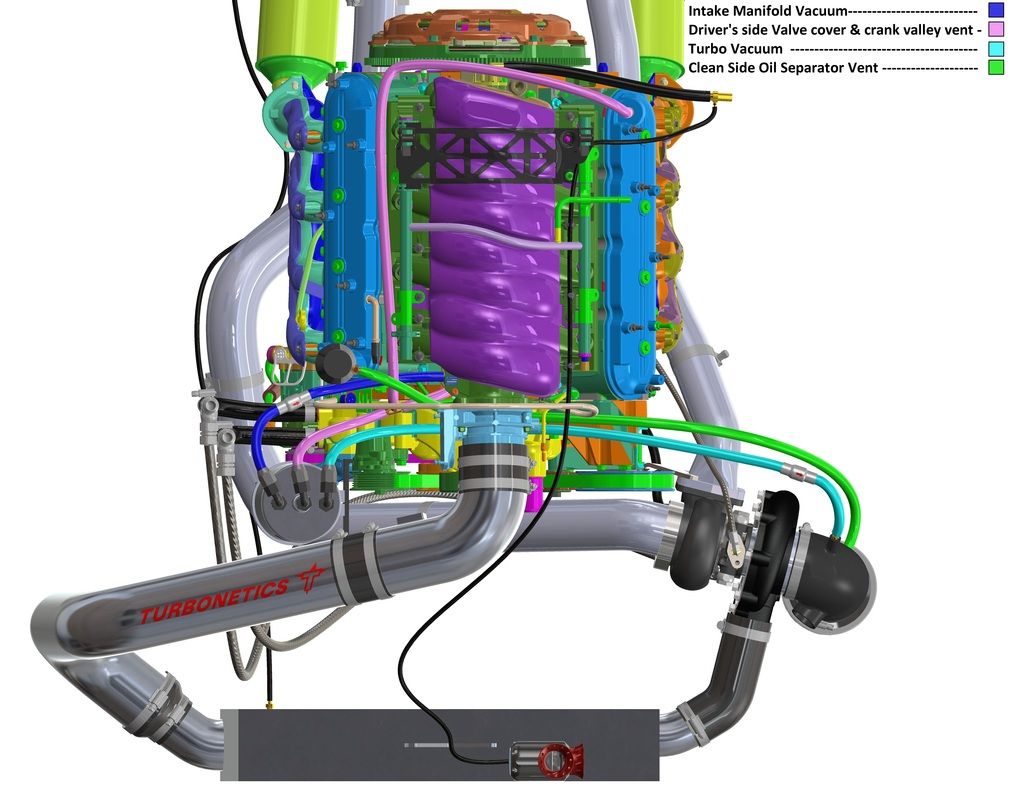
As you can see, the system spews nothing to the atmosphere. All is contained. The main separation can is 95-98% effective in separating and trapping all contaminants you do not want as part of the intake air charge. The cleanside separator replaces the oil fill cap and this is the pathway for all incoming filtered fresh air. If there would be an issue with damage to the rings/piston seal pressure would simply escape out of it, but instead of into the air, it would be into the main air filter, and as it also contains a separation chamber with coalescing media inside it filters most oil as well.
The checkvalves as you can see are inline on each outlet and open and close to always default to the strongest suction source no matter the mode, in boost or not, and these are in use on builds in excess of 1000-1100 HP with just the results as described.
We realize most performance shops do NOT come from the Professional Racing Industry side, and crankcase evacuation is looked upon simply as assumptions, but the science of all of this is pretty in depth. Watch this video on a simple NA small block Chevy to see the impact of venting VS pulling suction. Now this is the ideal solution as we cannot duplicate the amount of vacuum a pump will generate, but all the same principles:
These pumps will not last on the street without regular rebuilds as we do with our race cars yearly.
Questions? Ask. Your free to do as you choose of course with your engine, but we are constantly puzzled as to why anyone would use technology that went away in the 1980's in all types of Professional Motorsports when adopting so much else from the racing community. You invest a ton on a big power build, protect as best you can.
|

|

|